2
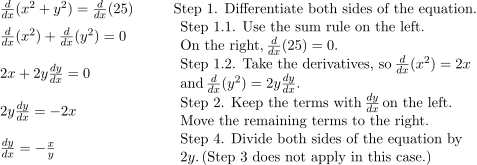
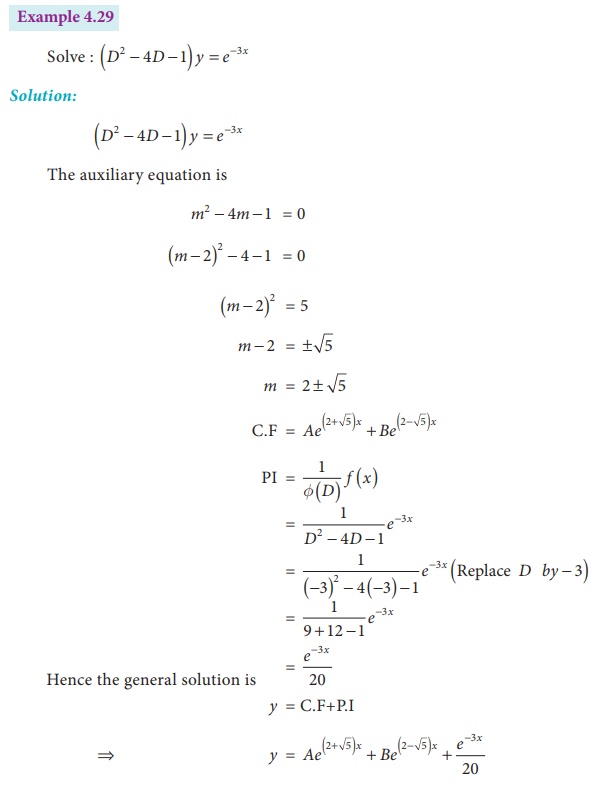
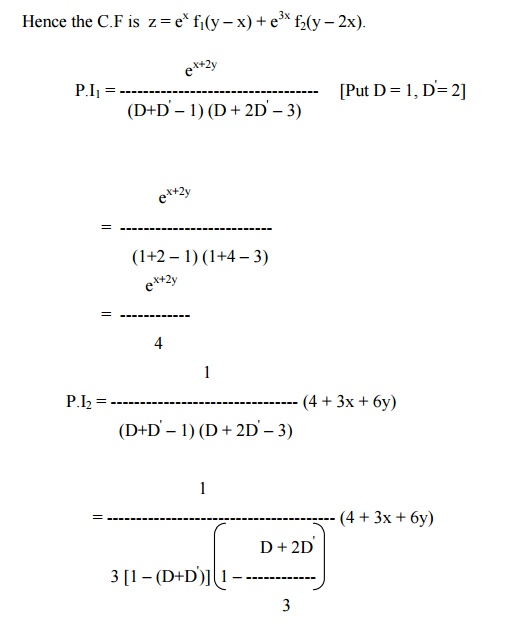
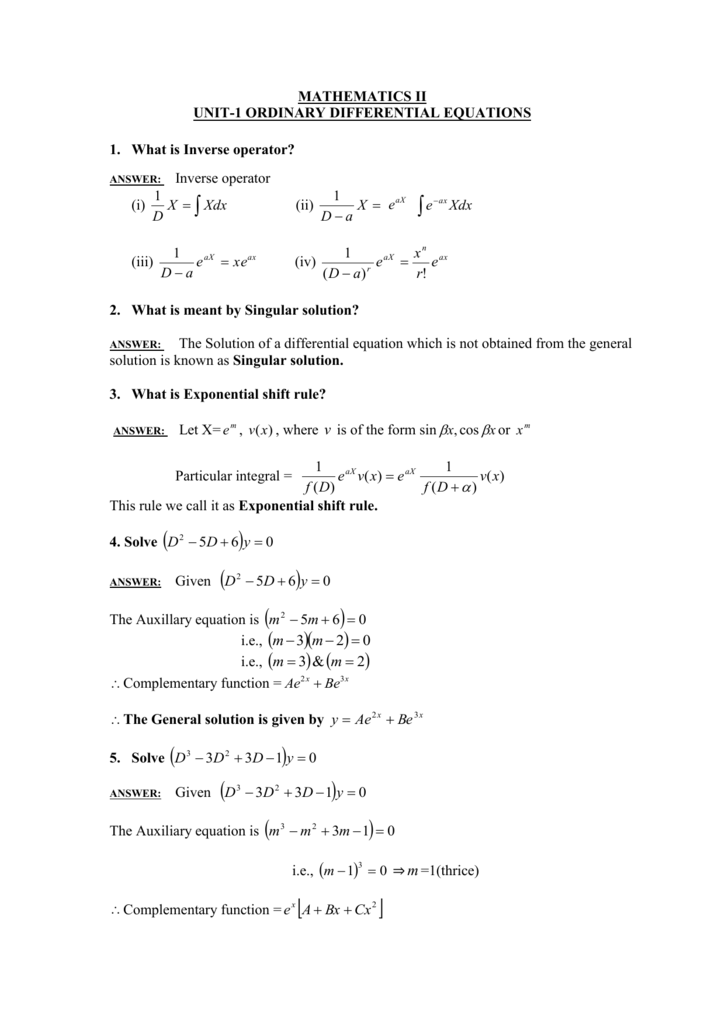
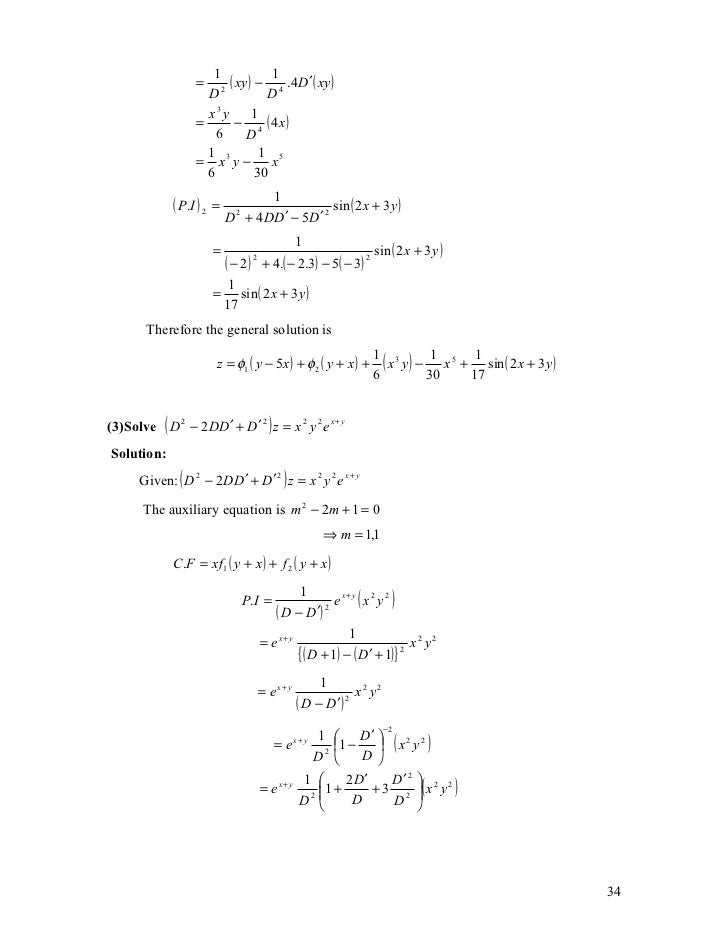
X=2t1, y=t^21 Natural Language;For the equation (D^2 1)y = xsinx the characteristic polynomium is m^2 1 =0 Roots 1 , 1 The solution to the homogeneous part of the equation is yh = C1e^x C2e^x For the particular integral use the operator 1/P (D) in this way 1/P (D)xf (x) = x (1/P (D))f (x) P' (D)/P (D)^2f (x)
(d^3-1)y=(e^x+1)^2
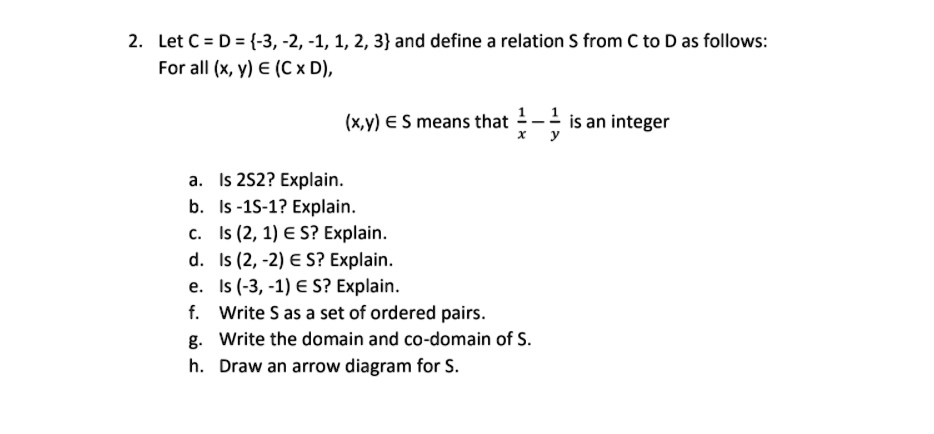
(d^3-1)y=(e^x+1)^2-Math Input Use Math Input Mode to directly enter textbook math notation Try it(a) 2 ∈ X (b) {2} ⊆ X (c) {2} ∈ X (d) 3 ∈ X (e) {1, 2} ∈ X (f) {1, 2} ⊆ X (g) {2, 4} ⊆ X (h) {2, 4} ∈ X (i) {2, 3} ⊆ X (j) {2, 3} ∈ X (k) X = 7 Show transcribed image text Expert Answer Who are the experts?
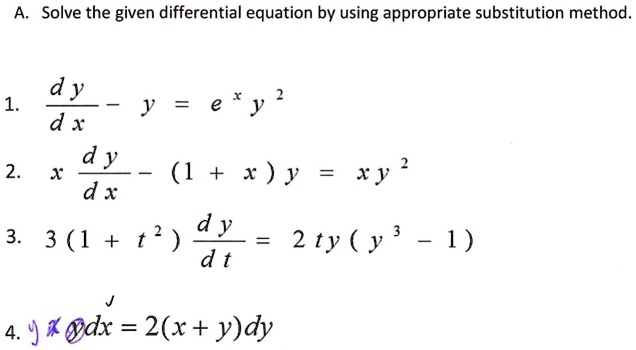
Solved Solve The Given Differential Equation By Using Appropriate Substitution Method Dy J E Y 2 D 1 1 Dy 1 Y 1y 2 D X 3 3 1 T D 2 Ty Y 1 D T 4 4 K Dx 2 X Y Dy
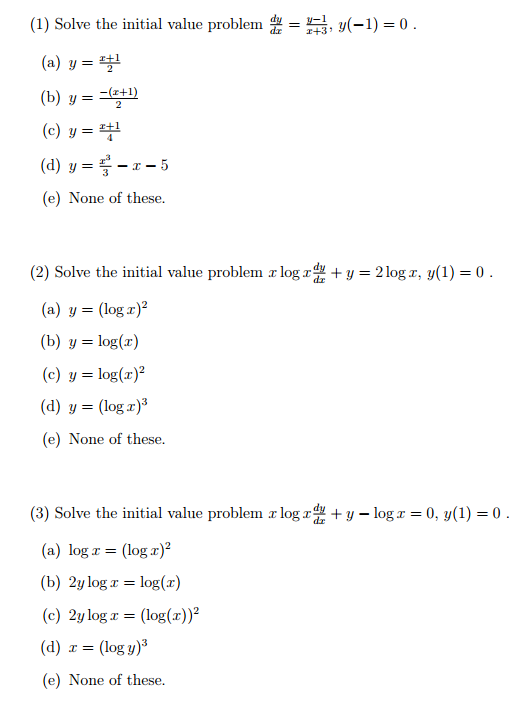
Remember that a BP Yn;3e1−cosθ (c) dy dx = ex2 y2 =⇒ y2 dy = ex 2dx =⇒ y3 3 = Z x 0 et dtC y(0) = 1 =⇒ C = 1 3 Therefore the solution is y(x) = 3 Z x 0 et2 dt 1 1/3 (d) dy dx = (1y2) √ 1sinx =⇒ dy 1y2 = √ 1 sinxdx =⇒ tan−1y = −2 √ 1− sinxC y(0) = 1 =⇒ C = π 4 2 Therefore y(x) = tan(π 4 2(1− √ 1−sinx)) 3 IntervalCorrect option is D) Given differential equation e y( dxdy −1)=e x y(0)=0 Find y (1)= ?
Which statements are true? e^3t is always positive, so all you need is 2t3 > 0 t > 3/2 e^3/2 = 448, and you can see from the graph that it is concave upward for x > 448 http//wwwwolframalphacom/input/?i=plotx%3De^t%2Cy%3Dte^tfor1%3C%3Dt%3C%3D2 👍 👎 🚩 Steve Similar Questions Chemistryσ 2 = 2
(d^3-1)y=(e^x+1)^2のギャラリー
各画像をクリックすると、ダウンロードまたは拡大表示できます
 | ||
|  | |
 | ||
「(d^3-1)y=(e^x+1)^2」の画像ギャラリー、詳細は各画像をクリックしてください。
 |  |  |
 | ||
 |  |  |
「(d^3-1)y=(e^x+1)^2」の画像ギャラリー、詳細は各画像をクリックしてください。
 | ||
 |  | |
 | ||
「(d^3-1)y=(e^x+1)^2」の画像ギャラリー、詳細は各画像をクリックしてください。
 |  |  |
 |  | |
 |  | |
「(d^3-1)y=(e^x+1)^2」の画像ギャラリー、詳細は各画像をクリックしてください。
 |  | |
 |  | |
 |  | |
「(d^3-1)y=(e^x+1)^2」の画像ギャラリー、詳細は各画像をクリックしてください。
 | ||
 |  | |
 | ||
「(d^3-1)y=(e^x+1)^2」の画像ギャラリー、詳細は各画像をクリックしてください。
 |  | |
 |  |  |
 | ||
「(d^3-1)y=(e^x+1)^2」の画像ギャラリー、詳細は各画像をクリックしてください。
 |  | |
 |  |  |
 | ||
「(d^3-1)y=(e^x+1)^2」の画像ギャラリー、詳細は各画像をクリックしてください。
 |  |  |
 |  | |
 |  | |
「(d^3-1)y=(e^x+1)^2」の画像ギャラリー、詳細は各画像をクリックしてください。
 |  | |
 |  | |
 | ||
「(d^3-1)y=(e^x+1)^2」の画像ギャラリー、詳細は各画像をクリックしてください。
 |  |  |
 |  |  |
 | ||
「(d^3-1)y=(e^x+1)^2」の画像ギャラリー、詳細は各画像をクリックしてください。
 |  |  |
 |
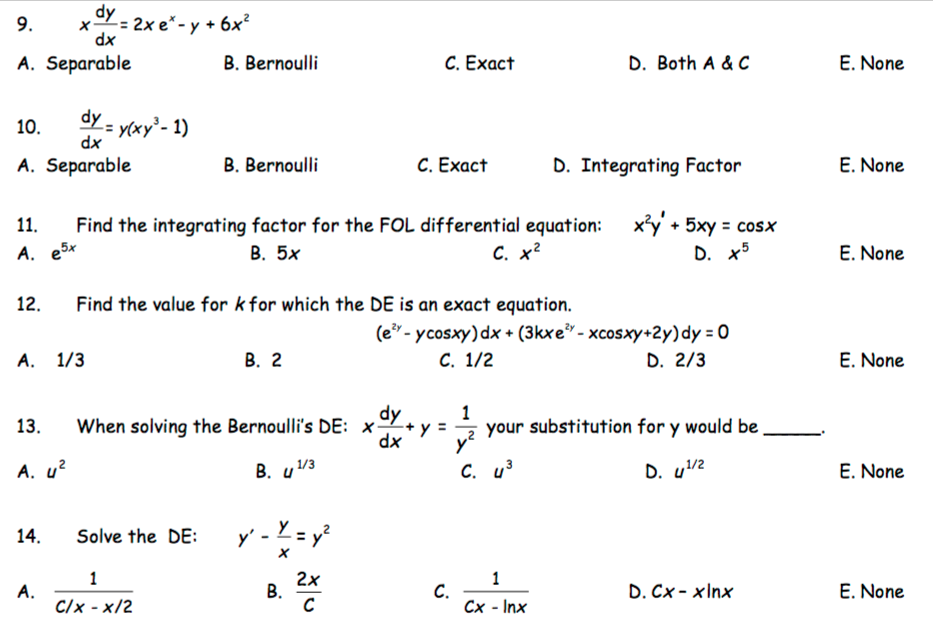
The standard approach is to find a solution, yc of the homogeneous equation by looking at the Auxiliary Equation, which is the quadratic equation with the coefficients of the derivatives, and then finding an independent particular solution, yp of the nonhomogeneous equation Complementary Function The homogeneous equation associated with A isThe solution of dxdy = 2xyx 2y 21 satisfying y(1)=1 is given by This question has multiple correct options A a system of hyperbola B a system of circles C y 2=x(1x)−1 D (x−2) 2(y−3) 2=5 Hard Solution Verified by Toppr Correct options are A) and C) Rewriting, the given equation as 2xy dxdy −y 2=1x 2 ⇒2y dxdy − x1 y 2= x1 x
Incoming Term: (d^3-1)y=(e^x+1)^2, 2(d^(3y)/(dx^(3))-3(d^(2y)/(dx^(2))+y=1+e^(x),


0 件のコメント:
コメントを投稿